





Arkansas Workers’ Compensation Insurance Lawyers
Arkansas workers’ compensation is not like filing a personal injury claim. When filing a personal injury lawsuit, the plaintiff must prove negligence to seek compensation. However, if you are injured at work, you do not need to prove negligence. The Law Office of Jason M. Hatfield, P.A. represents workers’ compensation claims from across Northwest Arkansas. Call us today for your free consultation at (479) 361-3575.
Fort Smith Attorneys with Decades of Experience
Arkansas employers use insurance to protect themselves from personal injury lawsuits and liability. Employers who have more than three employees are required to have insurance coverage in the event of their workers sustaining serious injuries.
To qualify for workers’ compensation benefits, you must suffer some injury, disability or illness related to your employment. Almost all accidents that occur on the job will meet this requirement.
It is essential to know that if workers’ compensation covers you at your place of employment, you are not allowed to sue your employer. There are exceptions to this rule if a third party is involved. If this is the situation, your workers’ compensation attorney at the Law Office of Jason M. Hatfield can explain the differences.
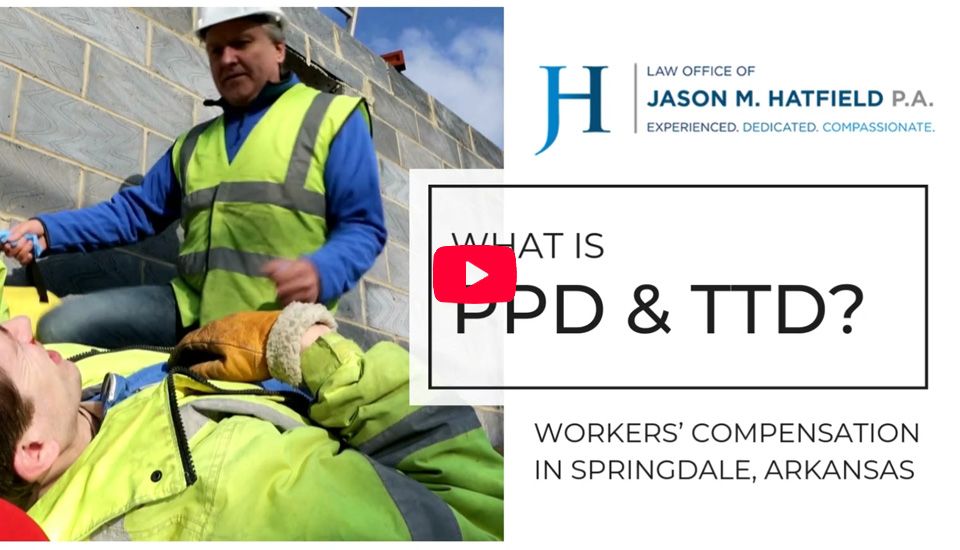
The Law Office of Jason M. Hatfield, P.A. helps injured workers across Arkansas understand their rights and fight for the benefits they're owed.
Who has workers’ compensation insurance in Arkansas?
By law, any Arkansas business with three or more workers must have workers’ compensation insurance. An employee must work with a company that has at least three or more workers to be eligible for workers’ compensation. Also, the injury must have occurred while the worker was performing their duties.
Eligible Arkansas workers include:
- Construction Workers
- Logging and Mining Workers
- Manufacturing and Warehouse Workers
- Retail and Hospitality Employees
- Healthcare Staff
- Police and Security Personnel
- Transportation Service Workers
- Other Professional Services
Which workers are excluded?
Ineligible Arkansas workers include:
- Federal Workers
- Farm Laborers/Agricultural Workers
- Railroad Employees/ Maritime Workers
- Independent Contractors
- Volunteers /Charitable Organization Workers
- Religious Organization Workers
- Domestic Workers
- Inmates
According to the U.S. Bureau of Labor Statistics Occupational Employment and Wage Statistics, the top three occupations in Fort Smith were meat and poultry trimmers and cutters, coil tapers, winders and finishers, and gambling surveillance investors and officers.
If you were hurt on the job, contact the Law Office of Jason M. Hatfield today to discuss your rights. If your industry is not listed, that does not necessarily mean it is not covered. We can help determine the next best steps for your unique situation.
What forms are needed for filing a Fort Smith workers compensation claim?
Employers who have more than three employees are required to have insurance coverage in the event of their workers sustaining serious injuries.
An Arkansas business may publicly post Form P, which tells employers what they must do in case injuries are sustained. It also shares the claims office telephone number and Arkansas Workers’ Compensation Commission if either the employer or employee needs help.
Under Form P, employees are instructed to give the employer notice of their injury through Form N and to notify a manager. If Form N is not completed, an injured employee can jeopardize their right to benefits. However, if there is no Form P, an employer can jeopardize using Form N in their defense.
If something is missed, it can complicate the next steps in obtaining medical benefits. It is best to discuss with an experienced Fort Smith workers’ compensation attorney to determine what to do next.
Arkansas workers’ compensation may not cover everything
Many workers are unaware that their workers’ compensation claim may not cover all expenses. While it should cover all necessary, reasonable medical treatment, there is a medical benefits expense cap of $10,000 on unapproved treatments. Although medical benefits can help cover current and future bills, some expenses may have to come out of pocket. Expenses an Arkansas worker could face include:
Lab testing
Healthcare provider billing statements
Medications and prescriptions
Medical equipment usage
Hospital overnight stays
Some vocational and physical rehabilitation
Types of Workers' Compensation Benefits
Every case is different, and injuries dictate which category of workers’ compensation a claimant would receive. It is not noticeably clear, and we understand that. We are here to help answer your questions. If you are eligible, depending on the type and severity of your injury, you may receive:
1
Temporary Total Disability (TTD)
You wait seven days before benefits start. The wage paid while injured is 66 2/3 percent, with a weekly minimum payment of $20. The maximum weekly payment is $953, or 85 percent of the state’s average weekly wage. The maximum time a worker receives payments is 450 weeks. A worker is paid the state average weekly wage, which varies yearly. This does not entirely make up for the loss of a paycheck. Injured workers may need additional funds to make ends meet.
2
Permanent Total Disability (PTD)Permanent Total Disability (PTD)
We will strive to help you, as the plaintiff, prove that makers, designers, and distributors are to blame. The process starts with identifying the manufacturer and proving fault in their product before leaving the production line. We also will show the item’s flaw and why it is the reason for your injuries.
3
Permanent Partial Disability (PPD)
he injured worker’s wage is 66 2/3 percent, with a weekly minimum of $20 and a weekly maximum of $715. Non-scheduled injuries have a maximum period of payment of 450 weeks, to a maximum amount of $176,400. When the TTD rate is more than $205.35, the maximum PPD rate is 75 percent of the total disability rate up to the max of $715. If the TTD rate is lower than $205.35, the PPD is determined at 66 2/3 percent of a worker’s average weekly wage to $154.00. After the age of 65, benefits incur a 50 percent offset.
Qualifications for receiving workers' compensation benefits
Qualifications for receiving workers’ compensation benefits in Arkansas can include the following:
- You were working at the time of the accident;
- Your line of work caused the injury you sustained;
- You can show that your work accident aggravated a pre-existing condition;
- Your injury is verifiable; and
- You are unable to physically work.
There may be other requirements to meet for being eligible for workers’ compensation, which depend on the case’s circumstances and the nature of the injuries.
Workers’ compensation claims can be denied
If your claim is denied, reach out to one of our Arkansas workers’ compensation lawyers at the Law Office of Jason M. Hatfield. We will review your claim and determine the next step. Typical reasons for claim denials include:
- The injury did not happen at the workplace;
- The employer was not notified immediately after the accident;
- The accident occurred because you were under the influence of alcohol or drugs;
- You did not go to an approved physician;
- You did not follow the doctor’s orders and complete the recommended treatments;
- Your injury was a pre-existing condition. The exception here is if your job made the injury worse, you might be eligible for benefits; and
- Your employer disputes your claim for benefits.
What types of accidents aren't covered?
Types of Accidents in Arkansas That Bar Claiming Workers' Compensation
While workers' compensation is a no-fault system, some types of claims are still not covered. These involve situations where a worker may be engaged in recreation or barred activities like fighting or using drugs or alcohol. The following situations can prevent you from recovering workers' compensation benefits.
Physical Altercations & Intentional Injuries
If you sustained an injury in a physical fight with another worker, or if someone can prove that you intentionally injured yourself while on the job, you cannot collect workers’ compensation.
Alcohol, Drugs & Recreation
If a worker were in an accident and reports revealed that they were under the influence of drugs and alcohol, or were injured while participating in recreational activities or horsing around at work, they could not file a workers’ compensation claim.
Emotional Injuries
Emotional injuries that arise without a physical injury are not typically compensable. However, there are some instances where a worker may suffer a disfiguring accident and develop PTSD, and treatment would be covered.
Heart-Related Injuries
Very few heart-related injuries are covered. There are some exceptions. If you can prove the injury was the direct result of an accident at work, you may be eligible for benefits.
Experience. Dedication. Compassion.
Contact the Law Office of Jason M. Hatfield P.A.
The Law Office of Jason M. Hatfield, P.A. represents workers’ compensation claims from Northwest Arkansas, including Fort Smith, Rogers, Berryville, Springdale, Fayetteville, Bentonville, and Harrison. Call us today for your free consultation at (479) 361-3575.